You listened to a fascinating podcast last week. You remember it was about sleep, or maybe habits, or both. You remember thinking: I need to act on this. You do not remember what you were supposed to act on. This is not a personal failure. It is neurobiology.
Hermann Ebbinghaus and the shape of forgetting
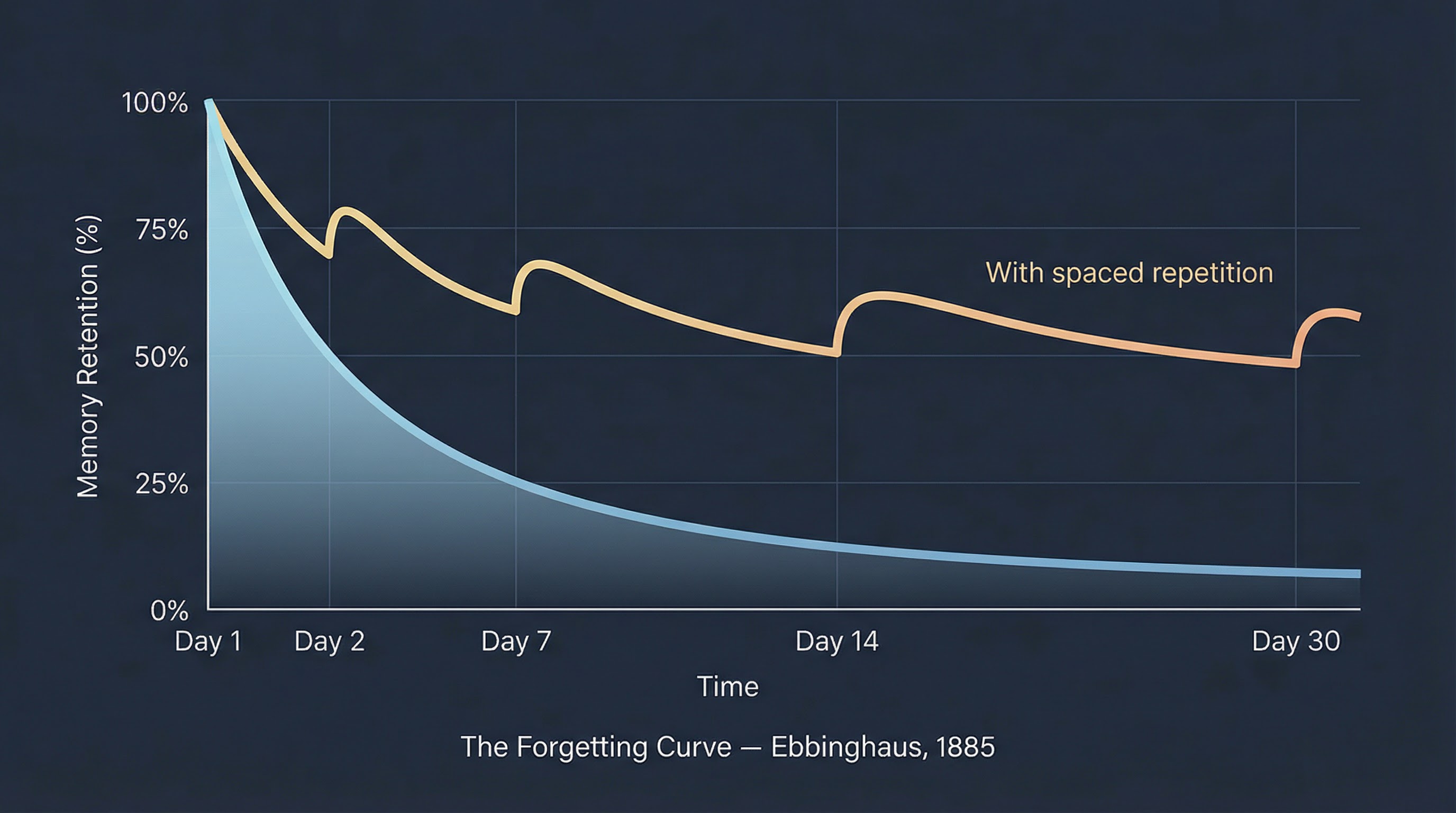
In the 1880s, a German psychologist named Hermann Ebbinghaus did something unusual: he used himself as a test subject and spent years memorising nonsense syllables, then measuring how quickly he forgot them. The result was a curve so robust it has been replicated in laboratories for over a century.
The finding was brutal in its simplicity. Without any intervention, we forget roughly 50% of new information within an hour. Within 24 hours, that number climbs to around 70%. By the end of a week, we have lost approximately 90% of what we encountered. The curve drops fast, then flattens. What little remains after a month tends to stick, but getting there requires something to push against the forgetting.
What the curve means for how we consume content today
Ebbinghaus was working with controlled, artificial material. The implications for real-world learning — particularly the kind that happens through podcasts, lectures, videos, and articles — are even more sobering. Emotional salience and contextual relevance can slow the curve somewhat. But the fundamental architecture of forgetting does not discriminate between a nonsense syllable and an insight you genuinely wanted to keep.
Think about your content diet from last month. The podcast you commuted to. The article you forwarded to someone. The documentary you stayed up to finish. Now ask yourself: what do you actually retain from those? Not the vague sense that you encountered something interesting, but the specific ideas, the concrete takeaways, the things that changed how you think or act.
For most people, the honest answer is: very little. Not because the content was bad, and not because they are poor learners. Because the brain was never designed to store everything it encounters. It was designed to store what it encounters repeatedly, in varied contexts, with time in between.
"The brain was never designed to store everything it encounters. It was designed to store what it encounters repeatedly, in varied contexts, with time in between.
The Learning Pyramid: not all input is equal
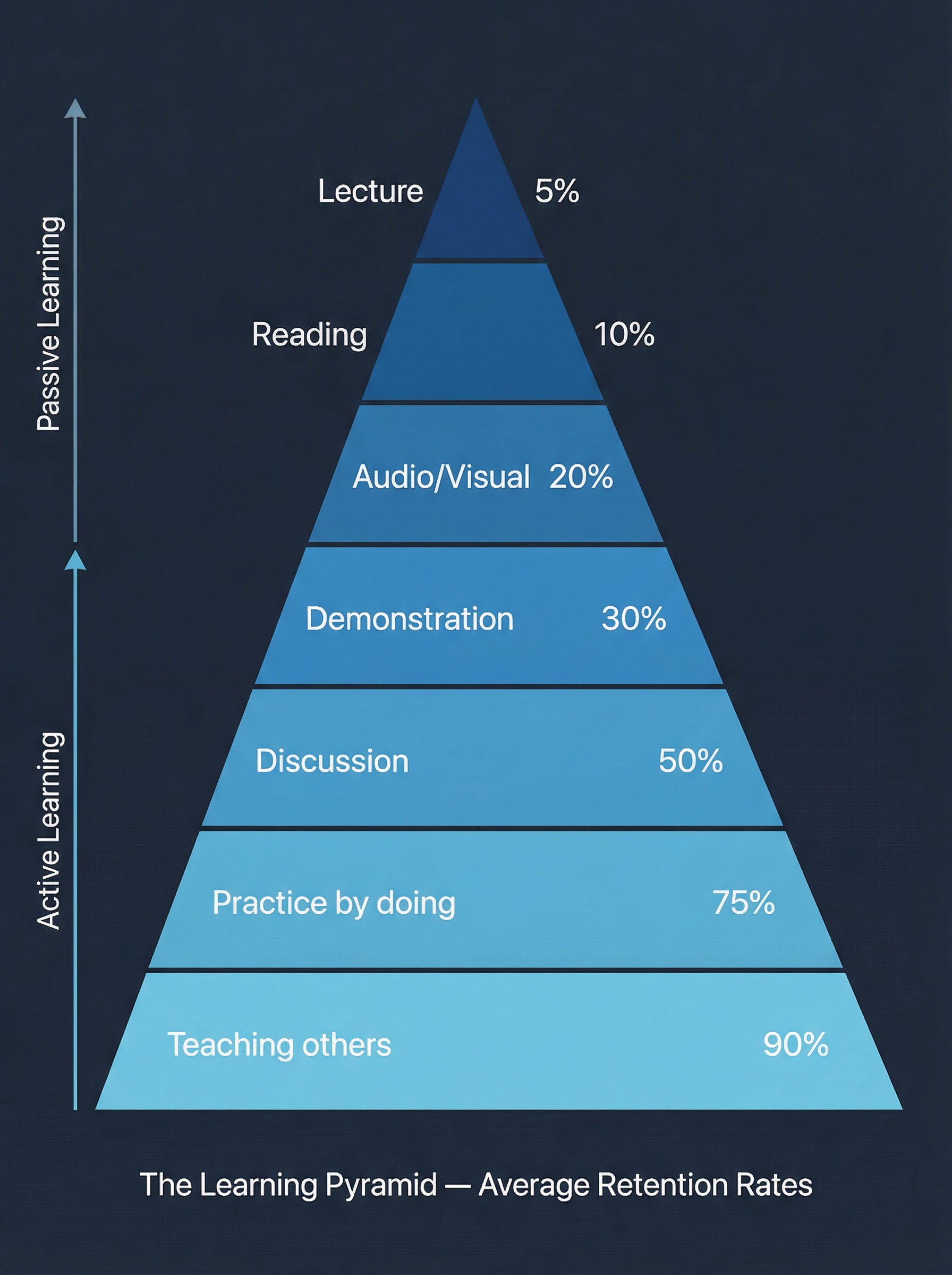
The forgetting curve tells us about the rate of decay. A complementary body of research — popularised as the Learning Pyramid and associated with studies from the National Training Laboratories in the United States — tells us something about the initial depth of encoding. The two are connected: information that is encoded more deeply to begin with decays more slowly.
The pyramid organises learning methods by their average retention rates. At the narrow top sit the passive forms: attending a lecture (around 5% retention), reading (10%), audio and visual material (20%). These are the methods most of us rely on most of the time. They are also the least effective at building durable memory.
The wide base of the pyramid is where retention climbs sharply: participating in a discussion (50%), practising the skill or applying the knowledge (75%), and teaching the material to someone else (90%). The pattern is consistent across the research: the more active and generative the learning process, the more the brain treats the information as worth keeping.
Why passive feels like learning
Here is the uncomfortable truth behind both models: passive consumption produces a strong feeling of learning without producing much actual learning. Reading a clear explanation, listening to an articulate speaker, watching a well-produced documentary — all of these activate the brain in ways that feel productive. The material flows in smoothly. There is no struggle. It makes sense.
That feeling is called fluency, and it is one of the most reliable sources of miscalibration in cognitive science. When processing is easy, we tend to judge our understanding as deep. But ease of processing and depth of encoding are not the same thing. In fact, research by Robert Bjork at UCLA on what he calls "desirable difficulties" suggests that some degree of struggle during encoding actually improves long-term retention. Making things slightly harder to process can make them significantly harder to forget.
This is counterintuitive enough that most people don't act on it, even when they've heard it before. Including, in all likelihood, after reading this article.
"Ease of processing and depth of encoding are not the same thing. When information flows in smoothly, we mistake the absence of struggle for the presence of understanding.
The spaced repetition answer
Ebbinghaus himself identified the intervention that most reliably fights the forgetting curve: reviewing material at increasing intervals over time. This is now formalised as spaced repetition, and decades of research confirm it is one of the most effective learning strategies available to humans.
The principle is straightforward. Instead of reviewing something once right after you encounter it, you review it again just as you are about to forget it, then again slightly later, then again after a longer gap. Each review resets and extends the retention window. Over time, the intervals grow long enough that the information has effectively moved from short-term fragility to long-term stability.
What makes spaced repetition hard in practice is that the optimal moment to review something is precisely when it feels least necessary. If you remember it easily, you have not yet reached the point of productive retrieval. The slight effort of pulling something back from near-forgetting is what strengthens the memory trace.
What this means for how we built Luna
At Luna, the forgetting curve and the learning pyramid are not abstract ideas we reference in team meetings. They are the structural reasons the product exists in the form it does.
The ability to highlight a moment mid-episode is an encoding intervention. The act of writing a note anchors the material generatively. Revisiting a transcript days later is a spaced retrieval event. None of these features exist because they seemed useful. They exist because the research on memory consolidation says that active, spaced, generative engagement with material is what separates listening from learning.
Podcasts are a genuinely powerful medium. The depth of conversation available through them is extraordinary. But a medium is not a learning system. The forgetting curve applies regardless of how good the episode was. What you do with it afterward is what determines whether it stays.
About the author
Rasmus Køstner
Neurobiologist · Luna