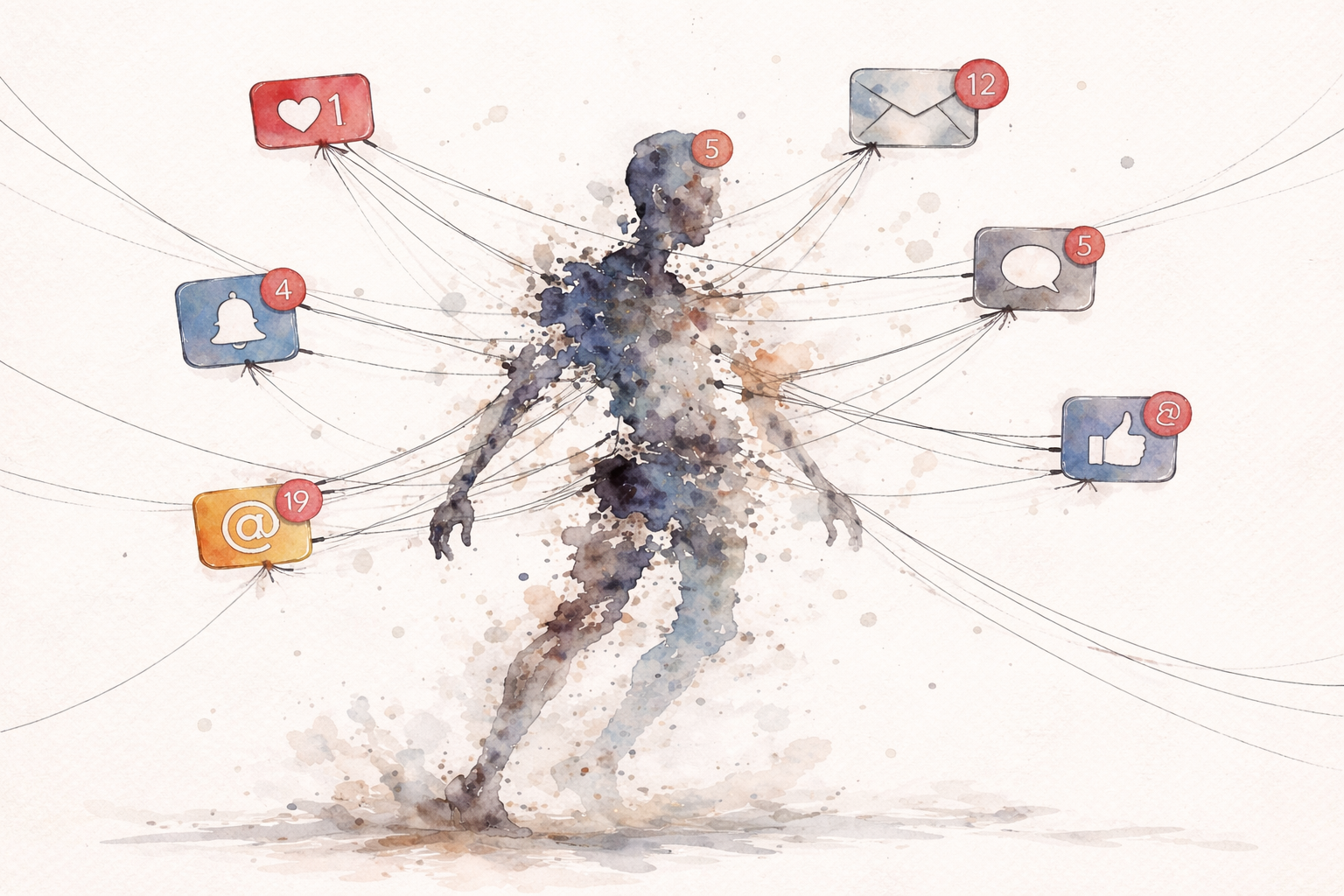
We live in the most information-dense period in human history. And in the middle of it all, here we are: scrolling, streaming, listening, rarely stopping to ask: is this actually what I want to spend my mind on?
The age we live in
The average screen time for adults is now somewhere between five and seven hours a day. We consume more content in a single day than someone in the 1800s encountered in a lifetime.
That last line is a joke. But only just. The actual source is a widely cited estimate from media researchers, and the irony of citing TikTok for a fact about information overload is not lost on us. Which brings us to the first real problem of our era: we often have no idea where what we know comes from.
In a world where a 60-second video, a peer-reviewed paper, a conspiracy thread, and a breaking news article all arrive through the same feed, formatted identically, with the same thumbnail energy. The burden of verification falls entirely on the reader. And most of the time, we don't verify. We scroll past, absorb the gist, and file it away as something we "heard somewhere." That somewhere is doing a lot of work.
Misinformation thrives not because people are gullible, but because discernment is cognitively expensive. Checking a source takes effort. Trusting the first plausible thing you see is the path of least resistance, and our feeds are designed to make that path as smooth as possible. The algorithm doesn't care whether what it shows you is true. It cares whether you stay.
The internet gave us access to all the world's knowledge. Social media gave us a firehose of opinions, meaning, and memes. Algorithms gave us an endless buffer that always had something next. And somewhere in that arrangement, the line between information and noise quietly disappeared.
"Discernment is cognitively expensive. Trusting the first plausible thing you see is the path of least resistance, and our feeds are designed to make that path as smooth as possible.
What attention actually is
Cognitive psychologists describe attention as a limited resource system: not a tap you can leave running indefinitely, but a reservoir. We can't process everything we see. The brain filters, prioritises, selects. What consistently gets our attention, over time, shapes how we think.
Gloria Mark, a researcher at UC Irvine who has spent decades studying distraction in the workplace, found that it takes an average of 23 minutes and 15 seconds to fully return to a task after an interruption. Twenty-three minutes. For a single notification. And we receive dozens of them an hour.
Deep, sustained attention activates the prefrontal cortex, the part of the brain responsible for planning, reasoning, and creativity. Fragmented, surface-level attention suppresses it. Every time we switch context — from article to notification to video to email — we pay a small cognitive tax. Do it enough times in a day, and the deficit adds up.
What we consume, and what it does to us
Learning podcasts
The podcast boom gave us something genuinely valuable: the ability to learn while commuting, cooking, running. Shows like Huberman Lab, Lex Fridman, and countless others have made long-form intellectual conversation available to anyone with a pair of earbuds.
But there's a trap most listeners don't see coming: passive listening feels like learning without being learning. Research from cognitive scientist John Dunlosky at Kent State University shows we retain surprisingly little from information we encounter only once, without active engagement. The brain processes the surface — the voice, the argument, the feeling of having heard something interesting — without actually encoding it into long-term memory.
The fix isn't complicated: pause. Reflect. Write something down. Come back to it. Those small acts of friction are what separate consumption from learning.
Research papers and academic content
Open access, preprint servers, science communicators on YouTube and Substack: we are, objectively, in the golden age of scientific accessibility. A paper published in a journal in Oslo can be read by someone in São Paulo within seconds of going live.
And yet. We share more research than we read it. Tweets linking to studies rack up millions of impressions; the actual papers are read by a fraction of that audience. An analysis published in Science found that between 50–70% of all academic papers are never cited after publication. Never cited, which means, in all likelihood, never meaningfully read.
We've built the infrastructure for a more informed world. We just keep sharing the headline instead.
News articles
Most people no longer read articles. They encounter them. A headline in a feed, a screenshot shared by a friend, a summary in a push notification. And that's it. The full piece, the context, the nuance, never makes it in.
The Reuters Institute's 2023 Digital News Report found that "news avoidance" is rising across every country they studied. People are actively opting out, not because they don't care, but because following the news has started to feel like a form of harm. It's too much, too fast, and almost always bad.
This isn't apathy. It's a rational response to an irrational system. News media is engineered for attention, not understanding. Clickable headlines, outrage cycles, and real-time updates are designed to keep you refreshing, not to leave you better informed than before.
Film and documentaries
Long-form documentary is one of the few content formats that still demands your full attention for more than ninety seconds. Films like The Social Dilemma, 13th, and Seaspiracy have shown that the format can genuinely move people, combining emotional weight with information in a way text rarely manages.
The problem is the wrapper. The next episode starts automatically. The platform serves you something adjacent. The deliberate choice to watch something specific quietly becomes an evening of algorithmic drift. The content was worthwhile. The session probably wasn't.
After TikTok: the endless scroll
In 2020, TikTok had around 700 million users. By 2024, that number had passed 1.5 billion. But the more consequential number isn't the user count. It's the average session length. People weren't just joining TikTok. They were disappearing into it.
TikTok didn't invent the endless scroll. It perfected it. Full-screen video, instant autoplay, and a recommendation algorithm so precise it could predict what you'd watch next before you knew yourself. The format is pure variable-ratio reinforcement: the same behavioural mechanic that makes slot machines so effective. You don't know what the next video will be. That uncertainty, that small electric possibility, is exactly what keeps the thumb moving.
B.F. Skinner mapped this in the 1950s: of all conditioning schedules, variable reinforcement is the hardest to extinguish. The behaviour continues long after the reward stops reliably coming. Every major platform looked at TikTok's numbers and redrew their product around this principle. Instagram Reels. YouTube Shorts. Snapchat Spotlight. The scroll became universal, and with it, the expectation of instant, effortless stimulation.
"TikTok didn't invent the endless scroll. It perfected it, and then every other platform redrew their product around the same mechanic.
The downstream effect isn't just that we spend more time on our phones. It's that our tolerance for slower, harder content has quietly eroded. A documentary that takes five minutes to set up its argument. A podcast episode that doesn't get to the point in the first thirty seconds. A news article without a video. These things feel harder than they used to. Not because they've gotten harder, but because we've been calibrated for something else.
The most unsettling part isn't the time lost. It's that we rarely notice it happening. It just feels like unwinding.
Consuming with intention
None of this is an argument for logging off. The answer to information overload isn't ignorance, and the answer to algorithmic distraction isn't a digital detox you abandon after four days. The tools exist. The content is often genuinely good. The problem is the relationship: the default, unconscious mode in which most of us consume most things.
There's a concept in Buddhism: sampajanna, meaning clear comprehension. Knowing what you're doing, why you're doing it, and whether it's actually serving you. It doesn't require meditation or monastic discipline. It just requires a pause — the kind that's become increasingly hard to find when the next thing starts before the current one ends.
Three questions worth carrying into your next session:
- What am I here for? Entertainment, learning, escapism. All are valid. But knowing what you're after helps you choose deliberately rather than drift.
- What do I take away from this? After a podcast, an article, a documentary: what do you actually remember? What shifted in how you think?
- What does my body feel like when I scroll? Calm, stimulated, anxious, empty? The body often knows more than we acknowledge. It's worth asking.
Your attention is finite. That's not a weakness. It's just physiology. But it does mean that where you point it matters enormously — in aggregate, over a lifetime. You are also, right now, in the middle of a vast commercial ecosystem where thousands of engineers, designers, and behavioural scientists work full-time to redirect it — away from wherever you intended it to go, toward whatever keeps you on the platform longest.
That's not a conspiracy. It's a business model. And the first move is simply knowing it's there.
About the author
Emilie Hemsett
UX Designer · Luna